

Three core elements to being a manager, Direction, Workbook
Helping you figure out your ships direction


Welcome to the workbook for our piece on Direction.
Below are some guided questions and exercises to help you do the ground work at setting your team’s direction.
What does your team do?
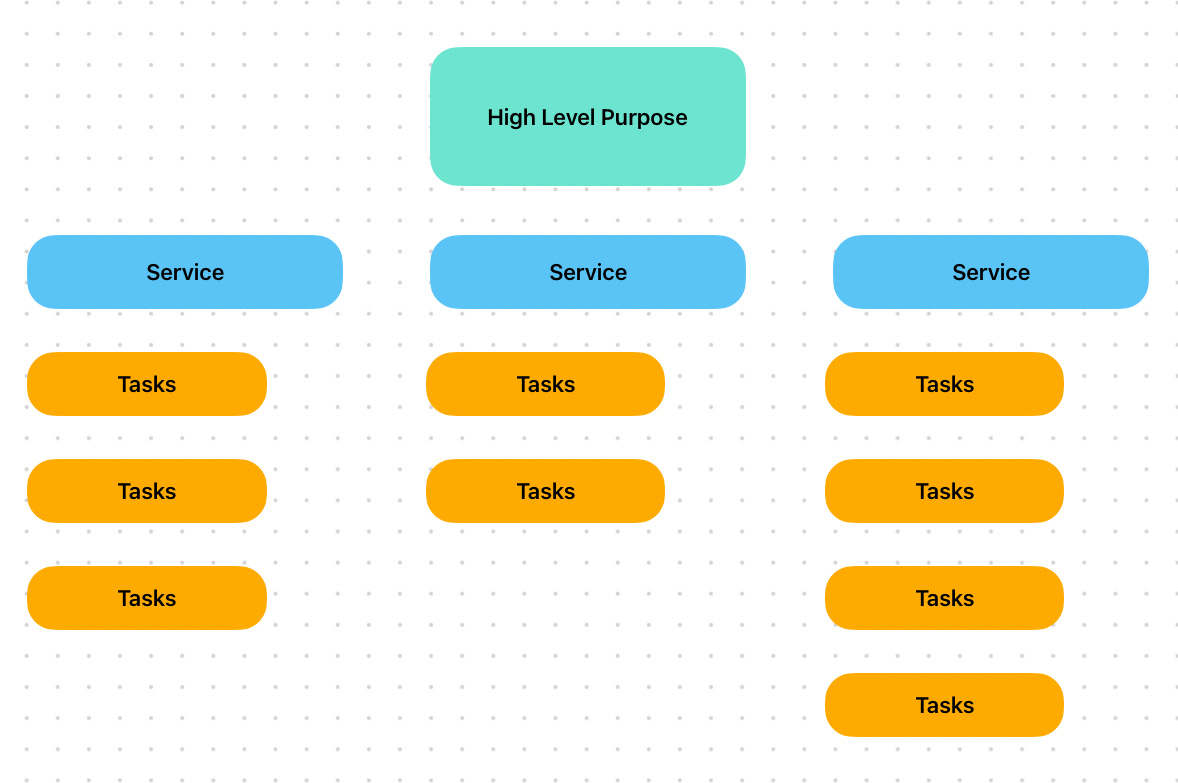
On a piece of paper, a word document, or a Miro board type solution…
At a high level, outline what your teams purpose is. This is really ‘what your team was established to do’ Keep it brief. It could be ‘to provide financial services to the organisation’ or ‘respond to external requests for information’. We’re really just using this as a high level grounding point.
Next, under that high purpose heading, create every individual ‘service’ your team provides. A service is that 'medium’ level (as in don’t get into the details) activity your team is expected to do by the business. An easy way to think of this is ‘if X work is needed to be completed, would the business expect your team to pick it up?’ If you’re a data team that could be: Carrying out analytics, maintaining a data warehouse, advising on the companies data, developing data products.
Finally, go down to the detail level and put those individual tasks your team does regularly under one of the service headings. If you’ve got something that doesn’t fit, maybe you're missing a service heading, or maybe your team is being asked to do something it really shouldn’t. Conversely if a service heading is empty, is that because it’s a crucial task that your team isn’t being given the time to action, or is something you wished you did, but the business doesn’t want it?
Finally, present this map to your manger/leadership to get their feedback. It’s important that everyone be on the same page about what your team does. Your leadership will be in a lot of conversations without you where ‘who can do what work’ will be discussed. With everyone on the same page their won’t be surprises.
Align to what the business is doing
There’s a couple of different things you need to get your head around at this stage, they may include:
What your companies overall strategy is. What specific goals are they working towards and how many of them require your team explicitly, and how many might require your team in an indirect way?
Does your ‘division’ have a seperate strategy, maybe you're in the IT group or the Corporate Services group. Have your superiors outlined their own strategy for the coming year or more? Again you need to understand how your team is expected to contribute to this strategy.
What are your stakeholders doing? In a perfect world, your stakeholders would communicate their needs in advance, but sadly we don’t. Talk to them to understand what their plans are and if any of them rely on you? For example, maybe you lead a team in the recruiting space, and a one of the teams has just been given additional funding for more staff and expect to hire twenty additional team members in the next quarter. That’s going to generate a lot of work for your team and you need to factor into everything else going on.
What you're trying to achieve here is a picture of whats coming your way. Companies are notoriously bad at communicating and planning ahead.
Everyone just assumes that the second they need another teams help for whatever project they are working on that the resource is going to be available immediately, and yet this is the polar opposite of reality. For the cost of a handful of meetings now, you can save yourself and other teams, lot of grief later down the line.
Try and get an idea of who needs your team in the coming year, when they need your help and how much time or staff they are going to require. You might write this down in a document, a spreadsheet, whatever works for you.
Finally, socialise this with your management. Let them know what’s going on that is going to have an impact on your team. It’s always important to have your leadership be aware of what pressures are facing your team, else they are going to sign you up to all sorts of work by accident.
Create your budget
To use accounting parlance, now we have a rough idea about what expenses your team is going to face in the future. Now we need to figure out how much money we actually have to face those expenses with.
You can do this anyway that works for you. Some people, like myself, tend to do more of a high level resource budget, just outlining what my ‘average’ capacity is at any one time, it gives me a feel for what our weekly budget is and I can plan from there.
Some people will do a weekly budget for every week in the year. Allowing them to map out when people are on leave and when certain projects need their attention.
This is a lot of extra work, but could be beneficial in certain circumstances. Say you have six teams who will need your team this year for their important projects. If all of them only need some of your time and they are spread out evenly throughout the year, probably no reason to panic. But if all of them need 50% of your team in the first week of October you're in trouble. If in doubt, let the circumstances of your situation dictate how deep you need to budget your team’s time.
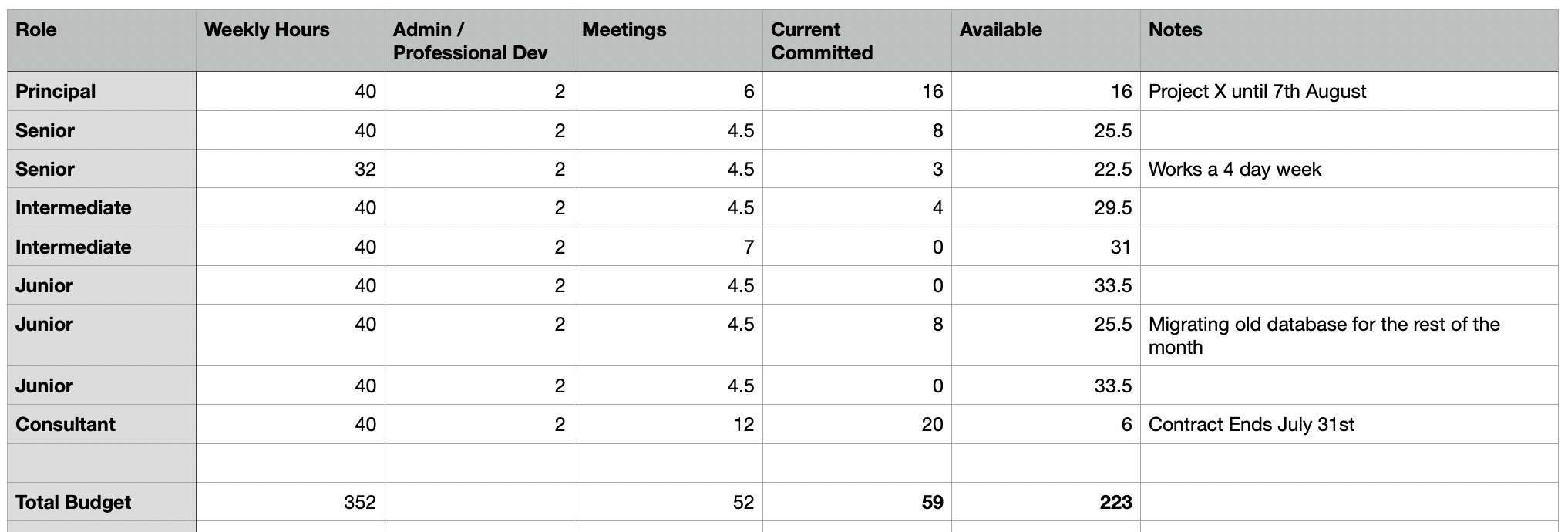
See the above example for how I would go about approaching a budget.
You need to calculate the following:
What the total budget would be in terms of hours at work. Normally Number of Staff times 40 hours. If you have less than 40 hour contracts then take that into account. If some people have flexible working arrangements such as 9 day fortnights or work three days, this needs to be reflected here.
You have to leave some amount of hours for admin and professional development. I’ve put 2 hours a week. Realistically that’s could be a lot more. You should be allowing your staff to spend about 1-2 hours a week/fortnight on professional development, depending on their needs. Then factor in all the other admin they have to do. If they get lots of messages and emails, or have to manage specific systems you could find your staff are loosing up to an hour a day or more to these activities before they even get to their actual role.
Understand the drain meetings have. I cannot stress how much time gets stolen by meetings. I once took over a team that had 30minute stand ups every day, a full hour long team meeting every week. A company wide town hall every week. Then those that were in agile configurations had seperate project stand ups, retros, and sprint planning. For some staff they were loosing 7-8 hours a week in repeatable meetings, then depending on the client and workload had several more adhoc meetings that week. You need to include this into your budget as it will shed the most amount of light on where the team’s time is really going.
Once you’ve taken total budget minus meetings and admin/professional development you're left with your true capacity. From there you can incorporate existing commitments and be able to get a clear enough picture of your total output.
However, please note the below:
Not all staff can perform the same functions. Many staff have their own specialties and expertise. You might have budget on paper, but if all your projects require one person, then you're going to have to work something out.
If you are a team with existing BAU commitments, you’ll need to factor these in. Granted BAU should undergo some level of prioritisation, but depending on the volume of requests coming in, you're going to want to keep the waters moving and not let the backlog fill up too much.
These are just rough numbers, as people go on leave and often work takes longer than we think it does, the reality of your budget is going to wax and wain. Use it as an indicative figure and give yourself a margin of error of at least 10%.
Finally, do not use this as a method to micromanage. You are doing this exercise for the purpose of getting a gauge on what your teams capacity is to handle incoming work. You are going to find that reality and your budget do not see eye to eye. This is primarily because most workplaces are fluid, people have good days and bad days. They have days where it takes them longer to deliver a piece of work because it was more complex than imagined, or the stakeholder gave poor direction. People are going to have days where they are answering lots of emails or are stuck in a lot more adhoc meetings and lastly your staff are going to have off-topic conversations all the time. They are going to pop out and get coffee, have a twenty minute chat with a colleague in the kitchen, or get sucked into whatever the people next to them are talking about. You need to keep that all in mind and accept it, do not use this as a tool to wring out every last drop of productivity you perceive you can get. Keep that margin of error in mind, and be pragmatic about your team’s budget.
What does the team want to do?
A key element of employee engagement is feeling like they have a hand in what they are doing.
When you are figuring out the companies strategies, and what other teams need from you it can be easy for your team to feel like they have no say or control. Like they are merely a tool the company welds.
Sadly there is a lot of truth to this, so it’s your job to work against that and give them the feeling of control.
To do this, your team needs to decide what they want to do as a team.
At this stage, I would recommend you hold a meeting, and spend the first part of the meeting communicating what you’ve learned above. I wouldn’t bother explaining the resource budget, that’s really for your eyes and could send the wrong message. But it’s important that you start explaining the big picture. What the business is going to expect from them, so that conversations around priority aren’t arduous.
Then with the rest of the meeting, brainstorm what the team would like to do. Don’t just take every idea, work with the team to understand what effort each task will require and what the payoff is. If you're busy, especially with priority work, you're going to have to work hard to make the time to work on these projects.
This is why I recommended to budget in that 5-10% time for other work, whether it be professional development, admin, or this bonus work.
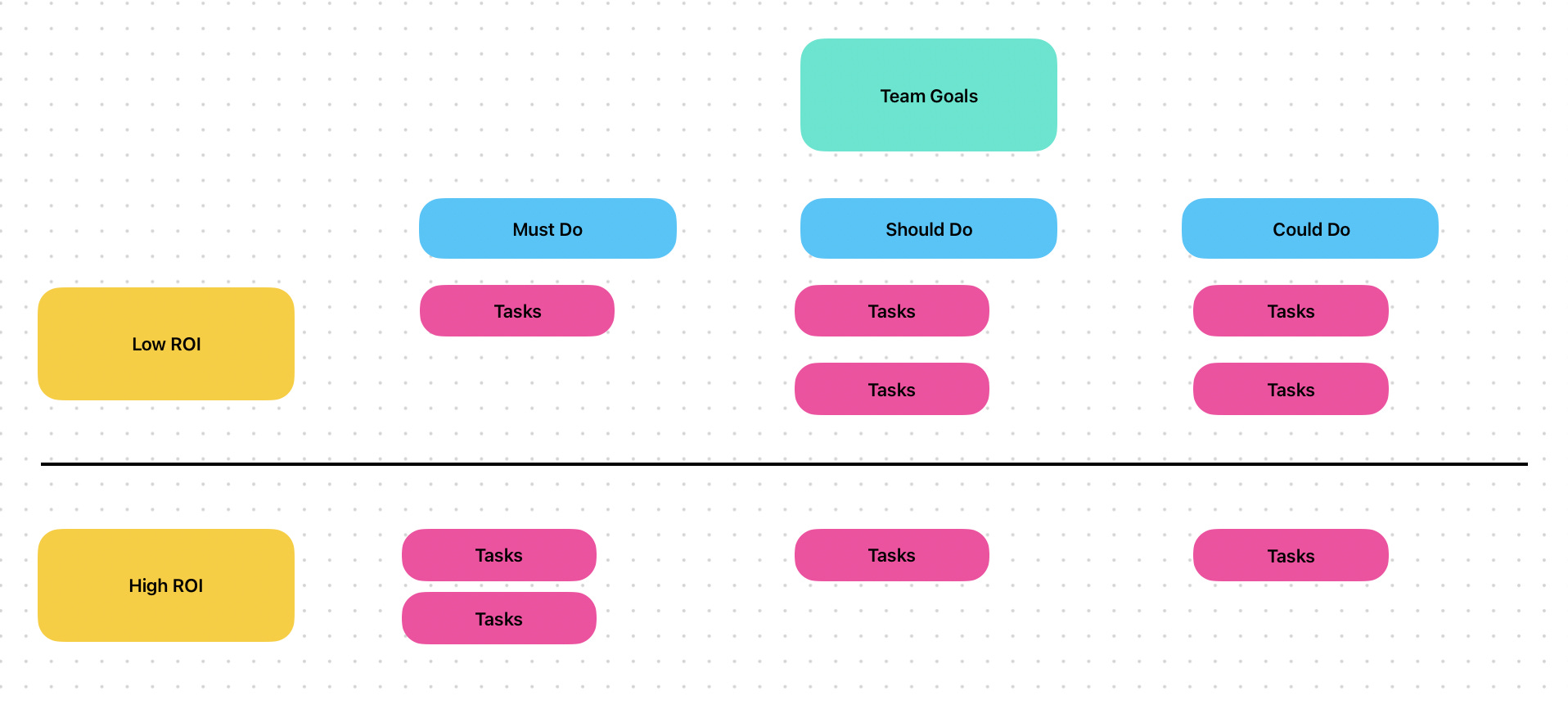
Map out the ideas into a MOSCOW format and then break them down into their Return on Investment (ROI) so you can see how feasible these tasks will be.
Next get the team to decide on around three. It’s tempting to want to do more. But it’s important to not over commit. Getting these tasks done is vital to getting the team to feel engaged in this process. At the end of the day if you get them all done you can come back to the brainstorm to pick up more.
Rinse Repeat
Whilst much of this work can be done once a year, some of it should be revisited often.
For example you may need to review your team budget from time to time as things change.
I strongly compel you to constantly be communicating and reminding your team about the strategy. This keeps your team’s eye on the prize and makes conversations about what you're working on simple. Hopefully if it works the team will keep each other accountable as they all know whats important and what isn’t
Something I do, is a make a map.
Using a Miro board, I create a big chart outlining the companies goals and the other external factors that impact on the team. I also include the projects the team have agree to tackle and some bold areas where priorities have been outlined and I refer to it at least once a month in team meetings.
💡If there is any topics you’d like to see covered on the blog or have any specific questions, feel free to drop a comment, leave a message in the chat or reach out to me on social media.